Thursday, October 13, 2011

Paul Krugman's Obfuscation About Adam Smith

Stuart K. Hayashi

This particular blog post by Per-Olof Samuelsson alerted me to something quite troubling. Nobel Prize-winning economist Paul Krugman quotes from Adam Smith's The Wealth of Nations to give his readers the impression that Smith is advancing a viewpoint that accords with Krugman's when, in fact, it does not.

In his usual snide tone, Krugman states,
One line I’ve been seeing in various places, including comments here, is the claim that the real way to deal with Wall Street is laissez-faire economics: no more bailouts! On this view, policy makers should raise their right hand in the air, place their left hand on a copy of Atlas Shrugged, and swear in the name of A is A that they will never again step in to rescue failing banks. And all will be well with the world. 
He then says, "First of all, bank regulation is important even in the absence of bailouts. Don’t trust me, trust Adam Smith. Scotland invented modern banking; it also invented modern banking crises; and Smith, having witnessed such a crisis, favored bank regulations..."

As evidence, Krugman quotes this passage from The Wealth of Nations:
Such regulations may, no doubt, be considered as in some respect a violation of natural liberty. But those exertions of the natural liberty of a few individuals, which might endanger the security of the whole society, are, and ought to be, restrained by the laws of all governments; of the most free, as well as or the most despotical. The obligation of building party walls, in order to prevent the communication of fire, is a violation of natural liberty, exactly of the same kind with the regulations of the banking trade which are here proposed. 
From such a quotation, we are led to believe that Smith is making a concession to Krugman's big-government view: to the mercantilist outlook that would eventually develop into Keynesian economics. However, when you read the Wealth of Nation paragraphs around the passage Krugman quoted, you find that the passage is part of a much larger argument that Smith is making. And that argument is actually contrary to Krugman's Keynesian intrusionism. Adam Smith was arguing in favor of a gold standard, wherein all paper money is backed by a hard metal.  The "regulations" Smith was urging were restrictions against the issuance of paper money that is not backed in any way by gold.

However, in the Keynesian economics that Krugman advocates, the federal government has rules in place that require that the quantity of monetary units in circulation can always increase by government fiat. The "stimulus" fiscal policies that Krugman espouses definitely preclude a gold standard.

The passage of Wealth of Nations that Krugman quoted was from Book 2, Chapter 2, Paragraph 93. In the very next paragraph, Smith talks about  this.
A paper money consisting in bank notes, issued by people of undoubted credit, payable upon demand without any condition, and in fact always readily paid as soon as presented, is, in every respect, equal in value to gold and silver money; since gold and silver money can at any time be had for it. Whatever is either bought or sold for such paper, must necessarily be bought or sold as cheap as it could have been for gold and silver.
Then in Paragraph 96, Smith continues,
It would be otherwise, indeed, with a paper money consisting in promissory notes, of which the immediate payment depended, in any respect, either upon the good will of those who issued them; or upon a condition which the holder of the notes might not always have it in his power to fulfil; or of which the payment was not exigible till after a certain number of years, and which in the mean time bore no interest. Such a paper money would, no doubt, fall more or less below the value of gold and silver, according as the difficulty or uncertainty of obtaining immediate payment was supposed to be greater or less; or according to the greater or less distance of time at which payment was exigible.
The "regulations" Smith was advocating were laws forbidding the arbitrary increase in the quantity of monetary units and laws upholding the gold standard.  Yet the ability of the government on increase the quantity of monetary units -- and the preclusion of the gold standard -- is essential to the Keynesian economics that Krugman sides with. And yet Krugman quotes Smith to imply that Smith is making concessions to a viewpoint more aligned with Keynesian governmental interference than with laissez-faireist hard-line gold-standard advocates like Ron Paul and, well, Per-Olof Samuelsson. You can see the Wealth of Nation paragraphs in question yourself over here in Book 2, Chapter 2. You can find the paragraphs in question (93-96) using the search words "payment was exigible".

Monday, October 10, 2011

Orwellian, Self-Contradictory Language from the New York Times

  Stuart K. Hayashi
The New York Times reports, "In a grim sign of the enduring nature of the economic slump, household income declined more in the two years after the recession ended [in June 2009] than it did during the recession itself, new research has found."

Um, if household income only worsened since June 2009, don't you think this indicates the recession didn't end
in June 2009? The Times is saying that the economy is worse in a period of supposed economic recovery than during the recession.

The same article continues, "The finding helps explain why Americans’ attitudes toward the economy, the country’s direction and its political leaders have continued to sour even as the economy has been growing."

Um, don't you think that if the trend since June 2009 has been for the economy to worsen, that indicates the economy has not been growing?

The New York Times reporter's verbiage is like something out of 1984 or Alice in Wonderland

Sunday, February 01, 2009

My One Complaint About 'Atlas Shrugged,' 2009

Stuart K. Hayashi

Writing this is an annual tradition for me, as February 2, 2009, marks 104 years to the day of Ayn Rand's birth. Of course, American culture associates the date of February 2 with yet another tradition. It is said that, on this day, if a politician crawls out of his hole and sees his shadow, then we will have sixty more years of federal farm subsidies.

A crusty old man once said to me, "I find Ayn Rand's writings v-e-r-y l-o-n-g - w-i-n-d-e-d."

I beg to differ with his assessment. On second thought, I don't even beg; his assessment is plain wrong. When I read a 1985 paperback edition of Atlas Shrugged, I enjoyed every syllable on each of its 1,084 pages. (Previously, I mistakenly said that this edition was 1,087 pages.) The prose sparked vivid images that made me feel as if I were gazing upon an exquisite painting.

Unfortunately, it all went by too quickly. Almost every other novel I read was much longer, or, at least, that's how it felt.

I was so enthralled by the grandeur of Atlas that I was quite sad to finish it. It was as if I were a small child again, and summer was coming to an end, and I was parting with a dear friend and playmate whom I would not be able to see again for the rest of the year.

And so I have only one complaint about Atlas Shrugged:


It was too short. :'-)


Saturday, February 02, 2008

My One Complaint About 'Atlas Shrugged,' 2008

Stuart K. Hayashi

Writing a post like this has become an annual ritual for me, so it's about time I do it again.

February 2, 2008, marks 103 years to the day of Ayn Rand's birth. The day of the month is of particular importance in American culture because, every February 2, if a politician comes out and sees his shadow, we will have sixty more years of the welfare state.

As for Miss Rand's magnum opus, I enjoyed every syllable on each of the 1,087 pages of the paperback edition I read. The prose sparked vivid images that made me feel as if I were gazing upon an exquisite painting.

I was so enthralled by the grandeur of it all that I was quite sad to see it eventually come to an end.

And so I have only one complaint about Atlas Shrugged:


It was too short.


:-)

Thursday, November 08, 2007

Delicious

Stuart K. Hayashi


Lately, I have been watching the burgeoning Objectivist community on YouTube...

Recently, Objectivist "Qtronman" has made an Objectivist video lampooning YouTube's most notorious "Creation Science" promoter, "VenomFangX," and exposing the illogic of his video "Proof God Is Real."

You can see Qtronman's video, "God, Time, Space and a Chocolate Bar" below.


Friday, September 28, 2007

The SuperFerry

Pablo Wegesend


I have so busy this past month, that only I'm able to blog about the biggest controversy in Hawaii --- The SuperFerry.

The SuperFerry is a group of boats that transports people between the different islands of Hawaii. This is something that should've done a long time ago. That way, we're not over-reliant on airplanes to visit the other islands.


However, some on Kauai don't want any visitors! They're angry that the SuperFerry will give Oahu residents another way to (gasp) visit their island. They want Kauai to be same way it was when they were growing up! (Nevermind that NO PLACE IN THE WORLD hasn't experienced change in the last 20 years)

These anti-SuperFerry fanatics believe that their utopia island would be ruined by Oahu people who would clog their highways, shopping centers, and commit crime, etc, etc, etc.

These anti-SuperFerry were so pissed off about it, that when the SuperFerry made it's 1st attempt to travel from Oahu to Kauai, some came on their surfboards to block the SuperFerry, they yelled threats, and vandalized cars!

Let's call those punks what they are --- Nostalgia Fascists! They're so set on keeping their island 100% the same as was in the past, that they'll use violent tactics against any change, no matter how minor!

If that's how they're gonna be, this is how we ought to deal with them

1) No Kauai Nostalgia Fascist would be allowed recieve non-Kauai assistance if their homes were damage by hurricanes, tsunamis, etc.

Those ingrates took advantage of all the help Oahu residents gave when their island was ruined by Hurricane Iniki in 1992. Many Oahu carpenters (my dad included) helped in renovating homes, airports, businesses, etc in Kauai after Hurricane Iniki. Those Nostalgia Fascists ought to be ashamed of themselves!

2) No Kauai Nostalgia Fascist would be allowed to visit anywhere outside Kauai!

Any of them want to visit Las Vegas? (most popular tourist destination for Hawaii residents)TOO BAD!

Any of them want to watch their young relatives on Kauai high school teams playing a game on Oahu? TOO BAD!

Any of them want to visit a long-time friend who moved to Maui? TOO BAD!

Any of them want to visit the volcanoes on the Big Island? TOO BAD!

Any of them have a curiosity of what it's like in foreign lands? TOO BAD! That's what they get for being rude to those who were curious of what it's like on Kauai!

=====

Meanwhile, some said the SuperFerry would help disabled people visit other islands, and give high school sports team a cheaper way to travel to the other islands to play in tournaments!

These people are the onese most hurt by those Nostalgia Fascists!


Sunday, September 02, 2007

'Consuming Hypocrisy'

This is a video starring and written by Rhys Southan. The music is done by Eliza Wren Payne, who briefly speaks in the film.

It originally appeared online on FreedomAds.Org in the year 2000.

Friday, February 02, 2007

My One Complaint About 'Atlas Shrugged,' 2007

Stuart K. Hayashi


I first posted a version of this piece on February 2, 2005. Re-posting it every year has become an annual tradition for me. --S.H.


February 2, 2007, marks 102 years to the day of Ayn Rand's birth. That day of the month is of particular importance in American culture because, every February 2, if a politician crawls out of his hole and sees his shadow, we will have 60 more years of the welfare state.

As for Miss Rand's magnum opus, I enjoyed every syllable on each of the 1,087 pages of the paperback edition I read. The prose sparked vivid images that made me feel as if I were gazing upon an exquisite painting.

I was so enthralled by the grandeur of it all that I was quite sad to see it eventually come to an end.

And so I have only one complaint about Atlas Shrugged:

It was too short.

Tuesday, October 17, 2006

The Coase Theorem Can Guard Against Any Adverse Effects of Global Warming

Stuart K. Hayashi


This originally appeared in Tali Satele's Critique of American Samoa's Government on Tuesday, October 17, 2006.


Shikha Dalmia has written many brilliant essays on subjects like illegal immigration, India's economic liberalization, and private financing of education in India.

Recently, I came across an intriguing piece she wrote about whether private property rights and market forces could alleviate any harm that global warming may impose in the next one hundred years.

I believe Coase theorem, devised by University of Chicago economist Ronald Coase, has important implications for addressing the extent to which carbon dioxide emissions from heavy industry may contribute to the harmful effects of global warming. That is to say that market economics and private property could be the most important tools to correct adverse effects of global climate change, if only so many government regulations did not stand in their way.

Three of the biggest problems that anthropogenic global warming will supposedly exacerbate are:

1. The spread of tropical diseases like malaria

2. Lands that were once arable no longer will be

3. Rising sea levels


Let us assume, for argument's sake, that the fossil-fuel emissions from the coal and oil industry really do worsen theese problems.

What should be done if an increase in average global temperature, which the coal and oil industries supposedly helped cause, causes malaria vectors to advance?

First, if malaria finds its way into the United States, then limited DDT use should be legalized. Fighting malarial mosquitoes in the U.S. would not lead to Americans spraying large clouds of malaria all over as was done in the 1950s. Malarial mosquitoes will stay away from a house if its walls are sprayed with DDT once every six months.

But the federal government has banned it in America.

Furthermore, if dangerous epidemics spread themselves throughout the U.S., then private communities should be able to find their own safeguards over whom is allowed to set foot on its grounds. Just as the state government of Hawaii has methods of inspecting visitor luggage to prevent "invasive species" from entering the Hawaiian ecosystem, private communities should be able to inspect newcomers or visitors for disease before entry.

If an infectious disease made its way into a private community, then its property values would drastically decrease. If an epidemic spread throughout America, then the owners of private communities may see fit to perform check-ups upon people before they move into the new community.

Also, a purely consistent laissez-faire night watchman state would hold individuals liable for spreading dangerous diseases. If someone gives me a terrible disease, then the infector has damaged the private property that is my body, and I should be able to sue for compensatory damages. This would mean that, if Person X carried syphilis and had sex with Person Y without informing Person Y, Person Y should be able to sue Person X to make up for the costs that this imposed on Person Y.

If such a legal system were implemented, people would take more precautions to ensure that they do not infect others.

Now we can move on to the agriculture argument.

Global warming alarmists say that the changing climate will harm agriculture because lands that are currently arable will lose their arability over decades, while other lands will become arable when they previously weren't.

If that is the case, then the "creative destruction" of the market should be allowed to commence. Owners of farmland that is no longer arable will liquidate their holdings in that real estate, selling it off to investors who can find a more profitable use for it. Meanwhile, investments will be made into the newly-arable lands in other parts of the globe.

What is the impediment to this? Federal farm subsidies and price supports. If the federal government finds that an agribusiness's productivity is dropping as a result of global warming depriving the agribusiness's land of its arability, then it would not be surprising if the federal government used taxes to bail out the agribusiness. his will erase the investors' incentives to liquidate their holdings in farmlands that are no longer productive.

Finally, it is said that global warming will cause sea ld destroy the homes of people in coastal regions. Some scream that beachfront properties will be further devastated by an increasing frequency of Category 4 and 5 hurricanes.

If it is true that beachfront property is under such assault, then private insurance companies should be free to raise their rates so high that people will be discouraged from building homes so close to the shore. Furthermore, the fact that beachfront properties may be submerged within a 30 year period will cause beachfront real estate to decline in marketability, thus discouraging developers from continuing to erect properties that are too dangerously close to shore.

What would stop that from happening? The fact that the federal government implements a National Flood Insurance program that compensates people who imprudently build structures so close to shore that they are destroyed almost every single year. When these structures are destroyed, the National Flood Insurance program provides the property owners with the funds they need to re-build the structures . . . that will be destroyed once again. Without the government's financial crutch, these people would see that they only lose money from continually building too close to shore, and finally more further inland.

And, finally, there is the issue of liability for all of the property damage for which anthropogenic global warming is blamed.

Suppose that a group of attorneys call upon experts who scientifically prove that fossil fuel emissions from the coal industry and petroleum rock-oil industry contributed to global warming. And suppose that they could scientifically prove that it was these industries' carbon dioxide (CO2) emissions that caused the average temperature, since 2000, to increase by a margin that othewise would not have existed had only non-human natural factors been involved.

If it can be proved that it was this margin that caused so many people to be infected with tropical diseases, or to have depreciation in agricultural real estate and coastal real estate -- that, without all of these CO2 emissions, these tragedies otherwise would not have happened -- then all of the aggrieved parties can file a civil action lawsuit against the industries that have contributed to the Warming.

The more expensive the lawsuits are for these industries, the more these industries will have an incentive to find methods of providing energy without contributing so much to adverse global warming.

For example, there is something called "the gasification of coal." To "gasify coal" is to burn the coal so hot that it converts into a gas that can be transported through pipelines.

Gasified coal provides just as much energy as regular solid coal, but it emits much smaller quantities of carbon dioxide.

Yet the reason why businesses refrain from gasifying coal is that gasification is much costlier than emitting higher quantities of CO2.

However, if civil action lawsuits kept driving up the coal industry's costs, making the industry lose billions of dollars, then we may reach a point where it becomes cheaper for the coal industry to gasify its product -- thus reducing the number of big lawsuits -- than to continue harming people and paying out so much money in damages.

Here, a leftwing critic may respond that the big coal and oil industries would win every single lawsuit that middle-class victims filed against them, since Big Oil and Big Coal have so much more money at their disposal.

A solution to that would be to legalize champterty -- the practice of allowing individuals to invest their money into lawsuits. If venture capitalists believe that some farmers and beachfront home owners have a strong scientific case against Big Coal -- but that these aggrieved parties are woefully outmatched by Big Coal in terms of capital -- then the venture capitalist can finance the plaintiffs' case under the agreement that he receive a percentage of the damages if they win.

Now, I am well aware that, as attorney Walter Olson frequently points out, a ridiculously litigious society can easily penalize businesses that have not done harm. This is because, even if the business defendant wins a tort case that was filed against it, that business still loses money by having to pay for the cost of its defense. Thus, I would recommend that the United States adopts the "loser pays" system of England and many other industrialized countries -- the loser of the lawsuit should pay the legal fees of the other side.

With such reforms in place, businesses can be secure from frivolous lawsuits even as tort law can be used to "internalize" the "externalities" of industry-contributed greenhouse warming.

As Julian Morris writes,

I have argued elsewhere (Morris, J., 2003: 'Climbing out of the Hole: Sunsets, Subjective Value, the Environment and English Common Law' [read the PDF of that here --S.H.] Fordham Environmental Law Journal, Vol XIV, No. 2, 343) that much more could be done to enable private parties to resolve environmental problems through the legal system. Most legal systems in principle enable the owners of private property to recover damages when that property (or the beneficial use of that property) is damaged by the actions of another, whether intentionally or unintentionally.

Morris observes that it would be difficult to compensate the victims of such problems in Third World countries for such harm, as what makes these nations poor is almost always their lack of rule of law. The long-term solution, of course, is for these countries to finally develop a system of rule of law in which the courts bother to enforce individual rights to life and private property rather than to ignore them or abrogate them.

In the meanwhile, if only the First World more consistently adopted the principles of a "night watchman state," it would more effectively utilize the institutions of private property and liability to ameliorate the level to which industry may add to the global warming problem.


Copyright © 2006 Stuart K. Hayashi. This piece may not be reproduced by any means without the author's expressed written permission.

Wednesday, August 09, 2006

Us vs. TheBus

Stuart K. Hayashi

This is a revised version of an op-ed I wrote that originally appeared in Hawaii Reporter on September 17, 2003.


Back in September 2003, Honolulu's residents were quite upset when the city's bus drivers went on strike.

Why was that such a big deal? Because Honolulu only has one bus company, the city government-owned Oahu Transit Services, Inc. (OTS), and, consequently, only one brand of city bus services, known simply as "TheBus" (a company doesn't need a fancy brand name for its service when it's the only game in town).

The strike would have been easier for people to cope with had the city had a competing bus service, say, "Better Bus," that tried to win the business of Honolulu's resdients by charging them for tickets than OTS does.

But it would be illegal for anyone to start a firm like "Better Bus" in Honolulu. One cannot start a private bus company to compete against the government's "TheBus," and, even if one could, TheBus's subsidies from the government would give it an unfair advantage.

This problem began in the 1940s. Back then, Honolulu had two major bus companies, with competition from transportation services using smaller vehicles called "jitney buses." Then the head of one of those major bus corporations, the late Harry Weinberg, convinced Hawaii's Public Utility Commission (PUC) that this cutthroat, dog-eat-dog competition was madness.

Invoking "the public good," Weinberg persuaded the PUC to grant his own organization, Hawaii Rapid Transit, Ltd. (HRT), a regulated monopoly through prohibiting any company from directly competing against it.

The PUC, which actually had the authority to make laws because the Legislature gave it that power, agreed. It forced jitneys off the street. (Tour bus companies like Robert's Hawaii never provided direct competition to TheBus; they only go to tourist destinations.)

Since HRT had no true competition, its service was terrible, and it treated its drivers shoddily (they had no competing bus service to defect to), causing strikes like the one we have now.

In 1971, Honolulu's then-Mayor Frank Fasi purchased HRT from Weinberg and converted it into today's government-owned corporation: OTS. The laws against competition remained.

Many people believed TheBus's tickets were cheaper than HRT's because the TheBus's were cheaper "up front" (i.e., "at the door"). They failed to notice that what really paid for TheBus's operations came out of their skyrocketing taxes. When factoring taxes into the price, TheBus's services were actually more expensive.

If TheBus were privatized and competition re-legalized, prospects would improve. Strikes would be less frequent because, if drivers were dissatisfied with pay at one company like TheBus, our hypothetical "Better Bus" could lure away TheBus's best drivers by offering superior compensation. And if drivers for one company did go on strike, at least you could catch a ride on the competitor's vehicles.

Plus, only people who actually ride buses would have to pay for their services, which is fairer than taxing non-riders (if poorer people cannot afford tickets, then private charity can help).

But what if competing bus firms made arrangements with one another to charge the same high price for tickets?

After all, many leftists often snidely remind us that even Adam Smith wrote in Book I, Chapter 10, Paragraph 82 of The Wealth of Nations,

People of the same trade seldom meet together, even for merriment and diversion, but the conversation ends in a conspiracy against the public, or in some contrivance to raise prices.


Leftists' recitations of that Smith quotation are ridiculous on multiple levels. First, there is no reason why anyone -- free-market advocate or not -- should accept an assertion as truth just because Smith said.

Secondly, those who cite that Smith quotation take it out of context when they use it to imply that Smith advocated the existence of antitrust law. Such was the case when, following his quotation of Smith, the late journalist Robert M. Rees said that free-market proponents "must be thankful for the antitrust and other legislation that keeps laissez-faire capitalism under control."

Actually, in the sentence following the aforementioned quotation (still Bk. I, Ch. 10, Para. 82), Smith says that it would be immoral for the government to pass any laws forbidding businesses from colluding on prices.

Then, in subsequent sentences, Smith attributes the existence of monopolies and cartels primarily to government regulations forbidding competition -- not unlike the PUC regulations forbidding competition against OTS's TheBus in Honolulu.

Finally, contrary to political cliches like Mr. Rees's, collusion has been historically unprofitable in the long term insofar as capitalism has remain unrestrained. John D. Rockefeller, Sr.'s Standard Oil proves it.

Myth: "Unencumbered markets gave Rockefeller an exploitative monopoly until regulators stopped him."

Reality: In the years before Standard's government-imposed breakup in 1911, it already competed against eight gigantic oil-refining corporations and a total of 147 refining firms. Its 90 percent market share from 1880 dropped to 64 percent by 1907.

Standard actually drove prices down. When Standard incorporated in 1870, kerosene cost consumers 30 cents/gallon; it cost 6 cents/gallon by 1897. In 2005 A.D. dollars, that's a price reduction from $4.61/gallon in 1870 to $1.41/gallon in 1897.

Why do I mention Standard Oil? Because Rockefeller occasionally tried to fix prices with competing oil refiners, but, every time that happened, greed tempted some "co-conspiring" firm to "cheat" and undersell the "price-fixers," restarting competitive pricing. The same happened when the U.S. steel industry tried collusion in 1907.

And, if free-market competition were restored for Honolulu's bus industry and its members then attempted collusion, the same would likely occur.

Thus, it would be optimal to privatize TheBus and re-legalize direct competition -- with no government subsidies allowed.

That wouldn't strongly threaten jobs either; a private bus company could save money by hiring experienced bus drivers instead of paying for the training of new ones, so a private company would likely rehire the government bus drivers now on strike.

In the end, privatization would allow all of us -- bus drivers and passengers alike -- to triumphantly ride off into the sunset.


Related articles by Stuart K. Hayashi:

"Privatized Systems, Public Benefits"

"'Natural Monopoly,' or Your Economics Teacher Doesn't Know What He's Talking About"


Recommended links:


"It's Time to Rethink TheBus" by Cliff Slater, Reason Foundation representative

"Bring Back Bus Competition" by Cliff Slater

"Monopoly" by Dominick T. Armentano,Ph.D.

"The Ghost of John D. Rockefeller" by Thomas J. DiLorenzo, Ph.D.

"Antitrust's Greatest Hits" by David B. Kopel, Esq., and Joseph L. Bast

"Abolish Antitrust!" by Edwin A. Locke, Ph.D.


This essay is Copyright (C) 2003, 2006 Stuart K. Hayashi, and may not be reproduced in any form without his expressed written consent.

Thursday, July 13, 2006

Nooooooooooooooooooooo!!!! :-O

Stuart K. Hayashi

Atlas Shrugged is being made into a movie and the front runner for the starring role is . . . Angelina "The Lips" Jolie (referral from: Brown 7/13/06)

I recall Atlas Shrugged explaining that it was wrong for the federal government to extort people's money and then send it to impoverished people's republics.

Angelina Jolie famously demands that the federal government extort your money and then send it to the Third World.

And she makes that demand after having read and publicly praised this book.

Why is this woman getting the role? (Because she has more box-office clout than anyone else; that's why.)

I know that an actress doesn't necessarily have to agree with her character's philosophy, but . . . geez Louise!

What next? How about casting Al Franken as John Galt?

And how about a cameo from Prof. Cornel West as Hugh Akston?

Thursday, July 06, 2006

The Estate Tax Is Fun . . . But It Won't Save You Any Money on Car Insurance

Stuart K. Hayashi


Note: This post also appears here, in Tali Satele's Critique of American Samoa's Government.


Warren Buffett, the world's second-richest person, is yet another leftwing billionaire who goes around blabbing about the depravity of laissez-faire economics and the glories of the welfare state.

Lately, he has been demanding the retention of the estate tax, a.k.a. "the death tax."

And why shouldn't he? He brags that he won't let any of his kids inherit the vast fortune he's built himself, since he wouldn't want them to become spoiled wastrels who feel entitled to properties they haven't even managed.

That may very well be Buffett's conscious reason for opposing the repeal of the estate tax. However, there may be other reasons why an investor of his stature would fear an end to this law.

In a Wednesday, July 5 op-ed released by the Reason Foundation, J. Peter Freire observes,

The estate tax weighs heavily on those who have asset-rich businesses, typically family businesses that have taken years to break even and accumulate value. When the owner dies and the children take up the reins, the estate tax comes into play, sometimes costing as much as the business itself. The heirs are then forced to sell the business before losing any more money. This is how Buffett came to own Dairy Queen and the Buffalo News, among other businesses, as they were being sold at lower prices than their actual value. In the latter case, Buffett bought the paper for less than what it would wind up making him each year.

Beyond providing Buffett with a bumper crop of businesses to purchase, the estate tax also provides him with customers. Any financial advisor will tell you that the major component of a sound financial plan is composed of asset allocation, not blue chip trades on the stock market. And that is why they recommend you purchase some life insurance to shelter your money from large taxes such as the estate tax. And why not purchase that life insurance from Buffett's very own insurance company, GEICO?


So I have bad news and good news.

The bad news is that the estate tax has provided "corporate welfare" to the world's second-richest man.

The good news is that he saved a bunch of money on investments by purchasing GEICO.

Sunday, June 25, 2006

Americarus -- And Those Who Expect Him to Fall

Stuart K. Hayashi


Recently, a fellow of mine wrote to me saying that he agreed with me that current hysteria over global warming harkens back to the 1970s, when "Malthusian" doomsday myths about "overpopulation" ran rampant.

But I believe that the reason why the idea that global warming will destroy humanity actually harkens back to a far older mythology that is deeply ingrained in both the West and the East.

The notion of Anthropogenic Global Warming Apocalypse resonates so strongly with the mainstream opinion leaders because it speaks to their brand of collectivism that has its roots in Ancient Athens.

My fellow pro-science, pro-reason, pro-individualism laissez-fairists often talk of Ancient Athens reverently because they look up to Aristotle. Well, I like Aristotle, too, but it seems to me that the collectivism and authoritarianism of his teacher, Plato, was more representative of what constituted mainstream thought in Ancient Athens.

Ancient Athens may have been far more individualistic than the animistic tribal cultures both before and during that time, but that civilization was still terribly collectivistc and authoritarian by the standards of a modern free-marketer. So it's not surprising that the Ancient Athenians believed and spread their traditional myths about how the cardinal sin is to take pride in your own abilities.

Who, asked the Ancient Greeks, was Oedipus to believe that he could control his own fate? It was through his very own attempt to control his own life that he catapulted himself toward disaster. Though, of course, how can he be responsible for this when the gods were so intent on denying him any free will in the first place?

The Greeks said that having pride in your own abilities is Hubris, and that this is the cardinal sin for which one must be punished.

Environmental apocalypse is so popular with our Zeitgeist because, on a subconscious level, it still clings to those old legends of Hubris. Our industrial civilization is full of Hubris, say the mainstream intellectuals. America is too confident in its own technological marvels and in having greater economic and political freedom than most nation-states. It's about time that our current god -- Mother Nature -- reach down its mighty hand to smack us, knocking that smug smile of self-satisfaction off the face of the developed world.

This is one of the worst aspects of Greco-Roman culture, and it pervades the popular Western (and Japanese) imagination. To the journalism community, the industrial West is like Icarus, becoming so haughty as he flies close to the sun. Well, say the journalists, the melting of Icarus's wax wings sent the poor boy to his doom, just as the melting of the polar ice caps will deliver us to a similar fate.

Icarus was punished.

And America, say the intellectuals, is following his lead. America is Americarus.

In the popular collectivist view of today's journalism community, America is a modern Tower of Babel. Who were those arrogant men in the Bible, who tried to build a tower so high that it could reach God? The Lord sure taught them a lesson when He smashed their tower to rubble and scattered its builders across the globe. It's only a matter of time, the anti-globalizers warn (or threaten), that the gods will smite us as well.

In every story of Greek hubris, there was only one way in which the protagonist could redeem himself. If only Icarus weren't so proud -- if only Phaeton humbly accepted his place and refrained from trying to drive Helios's solar chariot -- if only Arachne had kept her mouth shut and never proved herself to be a better seamstress than the goddess Athene, disaster could have been averted.

According to the popular collegian view, we Americans, too, must learn such humility, by learning to forego so much of our material comforts. The politicians, the press, and the academicians say we should stop being so conceited in our mastery of our natural environment. We should learn to live with less luxury, and to be more like the collectivist Noble Savages in the fevered dreams of Jean-Jacques Rousseau, Herbert Marcuse, and Kevin Costner.

That is a story going back to antiquity -- a story told by a governmental elite to its commoners, so that they would know better than to become part of a rather impoverished but individualistic (and therefore hubristic) merchant class unsatisified with its lowly social status and thus constantly trying to improve its living standards. And inheritors of that power elite's legacy -- today's opinion leaders -- mourn the fact that the the hubristic merchants have largely succeeded in controlling their own destinies and have gained such prominence in the West and even East Asia. That is wrong, believe many opinion leaders, and so there must come a day when our now-wealthy merchant class finally meets its come-uppance. That especially applies to the Phaetons and Icaruses of the coal and oil industries.

I believe that it is this well-estaslished attitude against individual autonomy that pervades ancient Greco-Roman-Judeo-Christian mythology that has made tales of Anthropogenic Global Warming Catastrophe so captivating to the witch doctors of our own time -- the witch-doctor "intellectuals" in the arts, humanities, social sciences, and especially media.

We are finally witnessing the era, they say, in which America -- Americarus -- will be smote by the left hand of God Gaia.

Tuesday, June 06, 2006

Schools and Diversity

Pablo Wegesend

The US Supreme Court is going to soon hear 2 cases, one from Seattle, and one from Louisville about public schools that admit only a certain percentage from each racial group for the sake of "diversity".

Click here to see article.

The idea that schools choose the race of it's students, for any reason, is ridiculous. Especially if it's a government school.

Our state of Hawaii is more racially integrated than most of the mainland. This state has the largest rate of inter-racial marriages and multi-racial people.

And we didn't get that way by having government schools choosing the race of it's students.

The real reason people had problems with segregated schools in the South pre-1960's, was because the government schools chose the race of it's students. Now, forcing schools to have a certain percentage of whites. blacks, etc for the sake of "diversity" is just as crazy! Let the people figure out their own way of dealing with diversity. That's what we in Hawaii have done.

Yes, a school like Waipahu High would have a lot of Filipinos, but anyone living in that school's district can go to that school. A school like Waianae High would have mostly Native Hawaiians, but anyone living in the district can go there. Hardly anyone in Hawaii has a problem with Waipahu High being mostly Filipino or Waianae High being mostly Native Hawaiian, because people can choose where they live.

Other schools have very different combinations of people, with Kahuku High having a lot of Polynesians and Caucasians; Roosevelt High having a lot of local Japanese and Native Hawaiians, or McKinley High having a large of number of immigrants from Asia and the Pacific (which, by the way, is where I, a Mexican/PuertoRican/Portuguese//German, graduated from). The people in those district choose to live among such diversity.

Yes, Hawaii has Kamehameha Schools, which admits only Native Hawaiians, but it's a private school. And even that has caused controversy. A person with 99% European/1% Hawaiian ancestry can go to Kamehameha School, but a 100% Samoan or a 100% Tongan can't go there, all because their ancestors landed on the wrong island

Saturday, April 22, 2006

The Moral Rightness of Disregarding Immigration Quotas

Recently, George Mason University economics professor Walter E. Williams wrote a piece on the subject of immigration quotas that warrants some response.

Here, on my page is a reply from Ken Schoolland, an associate professor of economics and political science at Hawaii Pacific University and the author of The Adventures of Jonathan Gullible: A Free Market Odyssey (serialized here). Some years ago, Prof. Schoolland met Dr. Williams in person.

Aside from the comments on immigration that shall be addressed below, we are generally fans of Dr. Williams's work.


___________________________


Walter E. Williams wrote,

My sentiments on immigration are inscribed at the foot of the Statue of Liberty:

"Give me your tired, your poor, Your huddled masses yearning to breathe free, The wretched refuse of your teeming shore, Send these, the homeless, tempest-tost to me, I lift my lamp beside the golden door."

These words of poet Emma Lazarus served as the welcome mat for tens of millions seeking liberty and opportunity in America -- legally. Being a relatively land-rich and labor-scarce nation, immigration has always been good for our country. Plus, for most of our history, there was a guarantee that immigrants would come here to work. The alternative was starvation.

With today's welfare state, there's no such guarantee. People can come here, not work and not starve because the welfare state guarantees that they can live off the rest of us.

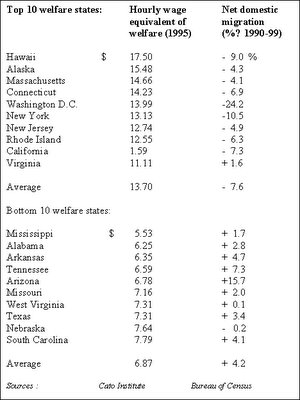
Ken Schoolland replies: The welfare state is not caused by immigrants. The cause is U.S. politicians. It is collectivist to say that immigrants should be deprived of liberty in America when it is native-born politicians who chose to create a welfare bribery system to win votes in the first place. Illegal immigrants don't qualify for welfare anyway.

In answer to the myth that welfare is the biggest predictor of what attracts migrants into a geographic region, one should note that, statistically, both native-born Americans and immigrants have a tendency to move away from U.S. states that pay out the most in welfare benefits and to move into U.S. states that pay out the least. A more significant predictor of whether one can expect migrants to move into a U.S. state is whether that is where many job opportunities are. When this trend occurs with U.S. states, why should we assume that it does not also occur in the case of nation-states?


Williams wrote,

At the heart of today's immigration problem is its illegality. According to several estimates, there are 11 million people who are in our country illegally, mostly from Mexico. Many people, including my libertarian friends and associates, advance an argument that differs little from saying that people anywhere in the world have a right to live in the United States irrespective of our laws or preferences. According to that vision, American people do not have a right to set either the number of people who enter our country or the conditions upon which they enter.

Prof. Schoolland replies: Thomas Jefferson et al. wrote in the Declaration of Indepencence,

WE hold these Truths to be self-evident, that all Men Are Created Equal, that they are endowed by their Creator with certain unalienable Rights, that among these are Life, Liberty, and the Pursuit of Happiness [emphasis added].

Observe that the document says "all men are created equal." It doesn't say, "Only those born within the thirteen colonies have rights." It says all men are "endowed" with the "unalienable Rights" to "Life, Liberty, and the Pursuit of Happiness."

It isn't only libertarians who espouse this, but most Americans every Fourth of July. If most of us truly mean these words, then are not those born in Mexico endowed with these same unalienable rights that, well, all men are? Since when did the U.S. Founders say that one only had these rights if one happened to be born within U.S. borders? Thomas Paine was not born in the United States; did he not have rights then?

Contrary to what Dr. Williams says, you do not need to have any immigration quotas or regulations to determine the number of immigrants that come onto your private property. On your private property, you can invite or not invite as many immigrants as you want. That does not give you the right to demand, with all the force of law (backed by the government's guns), that your neighbor be prevented from inviting as many immigrants as he wants onto his own private property.

Dr. Williams said himself that nobody has the right to dictate what you peacefully do with other consenting adults on your own private property. The logical conclusion to draw from this is that Dr. Williams has no business sending armed men after me or my guests if I invite dozens of Mexicans into my home every year when we commit no trespasses upon others.

Dr. Williams wrote in 2002 that "in the house, restaurant, airplane or workplace that I own, another doesn't have the right to prohibit smoking. If you don't like the fact that smoking is permitted in my restaurant, you can go elsewhere. Similarly, I can do the same if you don't permit smoking."

Paraphrasing Dr. Williams, "in the house, restaurant, airplane or workplace -- like a strawberry field! -- that I own, another doesn't have the right to prohibit my having peaceful Mexican aliens over as my guests or employees. If you dno't like the fact that Mexicans are allowed to work at my business, you can shop elsewhere. Similarly, I can avoid associating with you if you don't permit Mexicans onto your property.


In his recent column on immigration, Williams continues,

Some of the arguments and terms used in the immigration debate defy reason. First, there's the refusal to call these people "illegal aliens." The politically preferred term is "undocumented workers," which is nothing less than verbal sleight-of-hand.

Prof. Schoolland replies: Runaway slaves were also committing an illegal act. They were "stealing themselves" from their unrightful masters. During World War Two, Jews defied U.S. federal law when they fled Hitler and entered the United States when the U.S. immigration quotas would allow no more foreign Jews. The Founding Fathers of this nation were acting illegally. So
what?

"Laws don't determine morality" -- Walter Williams said those exact words to John Stossel in the 1997 TV documentary "Freeloaders." Has Dr. Williams changed his mind since then? Or is he being very selective and arbitrary when it comes to choosing the cases in which he will apply his own standards?


Williams wrote,

My colleague, Thomas Sowell, exposes some of this verbal sleight-of-hand in a recent column. He questions calling for "guest worker" status for people who, because they weren't invited, are not guests at all but gate-crashers. Sowell argues that the more substantive arguments for flaunting our immigration laws are just as phony.

Prof. Schoolland replies: Dr. Williams is wrong yet again. The "guest workers" are invited by any employer willing to hire them for the diligence they offer, the low pay, hard work, dangerous and dirty work they are more willing to do than many native-born Americans. And every American employee invites them to come and hire them in the businesses these immigrant entrepreneurs start up. They are invited by every business that wants to sell them food and clothing, by every landlord who wants to rent an apartment.

Was an invitation necessary for all the European settlers? No. They came for the opportunity, and dismissed native American "Indians" who might not have invited them. Indeed, invitations were made illegal when the immigration laws of 1882 outlawed contract immigrant labor.


Williams wrote,

How about the argument that "We can't catch all the illegals"? That's true, but should we apply that rinciple to other illegal acts? For example, we can't catch every rapist or burglar, but does it follow that we shouldn't try?

Prof. Schoolland replies: Does Dr. Williams believe that moving across the U.S.-Mexican border -- a line that exists only on maps and not on the actual soil of the Earth -- falls into the same ethical category as burglary and rape? Why is Dr. Williams comparing honest, peaceful employment to actual acts of violence? Because this country's immigration quotas outlaw foreign-born work within its borders, turning away people who are escaping to freedom from tyrants such as those of North Korea and Cuba?

I say that the criminal act is not in North Koreans escaping to freedom in America, but in Americans denying freedom to them by sending them back! That's a fugitive slave law.


Williams wrote,

The base motives for much of the political response to illegal aliens are fear of losing the Hispanic vote and pressure by employers who want to maintain a source of cheap labor. Politicians are calling for "guest worker" programs, but they're really calling for amnesty. They are fearful of actually using that term because they know it's political suicide, but the "guest worker" proposal is essentially the same as amnesty."

Prof. Schoolland replies: The major motive of politicians to stop immigrants is because those fearful citizens who have the vote are more powerful than those courageous immigrants who don't have the vote.


Williams wrote,

The word amnesty comes from the Greek "amnestia," defined in part as: "the selective overlooking or ignoring of those events or acts that are not favorable or useful to one's purpose or position." That's what the proposed guest worker program essentially says: Forget that you're here illegally.

Prof. Schoolland replies: Let's talk about something. Dr. Williams is siding with the U.S. federal government for putting quotas on the number of people, including Mexicans, allowed to come into this country every year and stay only on the private property of those willing to provide them with shelter or employment.

Dr. Wiliams supports that quota while opposing quotas of another kind -- quotas on the number of taxi cabs that may be operated in a city at a given time. Several cities have what they call a "medallion" system. There is a quota on the number of taxis in operation, and, for a taxi cabe service company to operate an additional cab, it has to obtain a permit called a "medallion." Walter Williams has proudly told the story many times of his operating an illegal, "undocumented," black-market taxi cab -- without any permit -- when growing up in New York. That was illegal, but he believed he had the right to give a ride to people despite the preferential laws that tried to exclude him on account of his not having a medallion.

If Dr. Williams believes it is right to operate a taxi cab without a government-authorized permit, then why does he oppose the right of a Mexican to obtain shelter from willing American providers on the providers' own private property without this Mexican having a government-authorized permit?


Williams wrote,

In principle, the solution to people being in our country illegally is simple. No one in the country illegally should be eligible to receive any social services except emergency medical services. Efforts should be made to deport illegal aliens. Our borders should be made secure both against illegal entry of persons and potential threats to national security.

Prof. Schoolland replies: Excuse me? Has Dr. Williams forgotten about private churches and private charities that give social and medical services to Mexican immigrants voluntarily? And yet the anti-immigration legislators are trying to have these private organizations punished for their aid to immigrants who do not have visas Of course, government forced payment for services should not be done for immigrants -- nor for native-born U.s. citizens.

Oh, and national security? Security of our rights does not routinely begin by first denying people their rights, both citizen and immigrant. If I want to hire a maid or gardener cheaply, so that they can live much better than in Guatemala and I can live better without doing cooking, cleaning, or gardening, then that is my right and it is none of the government's business. Williams should not be scapegoating these people for our national security woes. That has much much more to do with the shenanigans of the politicians in D.C. Of course, the politicians in DC already have their protected (often illegal) maids and gardeners, so it won't really affect them either way.


Williams concludes,

Finally, U.S. Citizenship and Immigration Services procedures for obtaining work permits and citizenship should be streamlined so that law-abiding people around the world can more easily contribute to and enjoy America's greatness.

Prof. Schoolland replies: Finally, something I can agree with.

Tuesday, April 18, 2006

A Distinction Between Freedom and 'Due Process'

Stuart K. Hayashi

The following is a slighlty revised version of an article of mine that originally appeared in the Tuesday, April 18, 2006 edition of Hawaii Reporter.It also appears here in the online 'zine Tali Satele's Critique of American Samoa's Government.


"Government is not reason; it is not eloquence. Government is force ... " --Apocryphally attributed to George Washington


Political freedom is security against spoliation. Dictionary.Com defines spoliation as "the act of...plundering."

More precisely, "spoliation" means the initiation -- that is, the starting -- the use of physical force against non-consenting parties' person or property. That includes larceny, kidnapping, and unintended property damage.

If you survived a stickup because you handed the muggers your wallet, the robbery still counts as violence, as you would've been killed if you didn't cooperate.

Contract violation (such as fraud) is also spoliation, as it's theft for me to promise contractually to pay you for something, and then take it without paying.

To secure our liberty from the rule of cutthroats, we entrust government to exercise retaliatory violence. The more someone resists our laws, the more violence the State responds with.

Suppose Murray never pays the compounding fines for his jaywalking offense. The city eventually sends armed men to apprehend him. Murray runs from them, so they mace him. If he fights back ferociously, he may need to be roughed up . . . or even shot.

Laws are ultimately enforced at gunpoint.

Cops are right to employ such force against spoliators -- pickpockets, rapists, swindlers, murderers, and abductors, all of whom start violence. But when it passes laws forbidding peaceful behaviors, the government itself spoliates innocent individuals.

Here critics scoff, replying that citizens implicitly consent to anything democratically-elected legislators decree. I disagree, for ancient Athens was doubtlessly wrong to vote democratically on executing Socrates for his rhetoric.

Of course, U.S. authorities cannot detain or bludgeon civilians arbitrarily. America, unlike Third-World dictatorships, has "due process of law," which places numerous procedural barriers in front of officials before they can kill a lawbreaker without being penalized for it.

However, just because America's Founders set up "due process" to rein in frivolous prosecution, that doesn't mean that "due process" equals freedom. That confuses means with ends. If you lock jewels inside a chest, you wouldn't say the chest is itself a jewel; the chest's purpose is to protect jewels.

Now imagine some democratically-elected lawmakers enacting legislation to incarcerate someone for three years if she houses a cat. Angela illegally keeps one anyway, harming nobody. Neighbors see the pet and snap pictures of her with it.

Eventually, detectives grow suspicious. After they show "probable cause," a jurist awards them a warrant to search her residence, where they find the animal. They read Angela her "Miranda rights" and book her. She gets her phone call in custody. Because she cannot afford an attorney, the state provides her one.

Angela only gets convicted after prosecutors demonstrate beyond any reasonable doubt to impartial jurors that she kept a cat, calling her neighbors as witnesses, displaying their photographs, and exhibiting the evidence taken from her premises. Angela appeals her sentence, but it's consistently upheld since judges find it obvious that she in fact did the crime.

Throughout this entire scenario, Angela received "due process." Investigators could only search her estate because they secured a warrant after establishing "probable cause." Angela got her requisite phone call, reading of "Miranda rights," jury trial, counsel, and appeals, and the onus was upon the prosecution to prove her lawbreaking irrefutably.

Yet the State still violated Angela's rights, because it threatened violence upon her for actions that didn't hurt anyone else's body or private belongings. Her guards would've manhandled her if she tried to flee the courtroom.

Though the above case is imaginary, real-life democratic governments with "due process" really can -- and often do -- promise to imprison people as punishment for peaceful-but-illegal behaviors, with even greater force reserved for those who attempt to escape their captivity. Such measures amount to government-enforced kidnapping.

Government kidnaps those who privately smoke recreational marijuana in their own homes, for example.

Likewise, you cannot legally hire a willing adult who offers to work for you for hourly compensation below the mandated minimum wage. If you're caught doing that and don't pay the fines for it, you can expect government to abduct you over it.

"Due process" won't save you from the slammer if you openly disobey a wicked law that never should've existed. America had long-established "due process" in the 1940s, but that wouldn't have prevented police from locking you up if you, in fact, flouted racial segregation laws back then.

True freedom requires that laws only prohibit spoliation -- not peaceful, mutually consensual activities among legally-competent adults, whether they are personal or commercial in nature.


Related articles by Stuart K. Hayashi
* "The Invisible Gun" (FreelyThinking.Com Version, Mad Prophet Version, Jacques Tucker's Website Version)
 
* "What Capitalism Is and Is Not" 
* "Freedom Before Democracy" 
* "The Properness of Property" (Pt. 1)
 
* "The Myth of the Social Contract" (link goes to the first of several installments)
 
* "Conservative Author Michelle Malkin Defends FDR's Policy of Mass Kidnapping"
 
* "Positive Reform Through Good Philosophy"
 
* Campaign Finance Follies"


Recommended Links 

* In Hawaii, convict shot in head as he attempts escape -- story here

Saturday, April 15, 2006

Freedom Before Democracy

Stuart K. Hayashi

Note: This is a revised version of a piece of mine originally published in the April 4, 2002 edition of Hawaii Reporter.

To make the record clear, Adolf Hitler was not directly elected by the general public to the office of German Chancellor. However, the members in the German Parliament -- whose members were each democratically elected -- did, through a majority vote, democratically ratify a bill that gave arbitrary "emergency powers" to Hitler. So democracy -- if we take the term to mean the elevation of majority votes above that of intransigent individual, private property rights -- cannot be taken off the hook here.


Almost everyone believes that democracy equals freedom.

Not surprisingly, anti-capitalist activist Michael Moore often invokes democracy. “I’ve read the U.S. Constitution, and the word ‘shareholder’ doesn’t appear once in it,” he says. “It’s a Democracy!" (Actually, the word democracy doesn’t appear in the Constitution either.)

When campaigning in Hawaii, Green Party 2000 Presidential candidate Ralph Nader said that those who weren’t out lobbying for more stifling regulations were necessarily mindless “gazers and gawkers.”

His “solution” was that we revive the ancient Greek concept of the “public citizen,” which said that all men must be politically active -- or otherwise be looked down upon by eveyrone else in the community. “Freedom,” Nader insists, “is participation in power.”

But democracy and freedom aren’t always the same. If democracy is so perfect, then why did the majority of Germany's democratically-elected parliamentarians vote for the 1933 Enabling Act, which gave Germany's appointed Chancellor, Adolf Hitler, an unlimited authority to make his own laws? Hitler himself was not elected, but an elected legislature nevertheless gave him absolute political power in a democratic vote.

Democracy is correctly defined as a political system in which laws or lawmakers are chosen by the majority of voters.

Meanwhile, Nader’s claim notwithstanding, freedom is not “participation in power,” but security against power. Specifically, it means that people can rest assured knowing that the power of physical force cannot be initiated upon their life, liberty, or property, by anyone -- not even a government -- even if 100 percent of the population approved.

That is what a good government protects us from; not imposes upon us.

For instance, let’s say democratic voting always won out over individual rights. Then, if the majority of the citizens disliked a group of rich people, it could democratically vote on whether they should all be executed, even though they have inflicted no harm to the life, liberty or property of others.

If at least 51 percent of the votes choose “kill,” then these rich people are massacred by the state.

Fantasy, you say? Actually, this happened periodically throughout the history of the ancient Greek city-state of Athens. Even back then, the majority claimed to represent “the people as a whole,” even if it was only 50.99 percent.

They disregarded the fact that there never was a “people as a whole,” since every person is an individual, with his own preferences, motives, and life. A “group of people” is only a group of individuals, each acting upon his own free will -- never a true collective.

Some might say, “People would never democratically vote for something as awful as mass murder today.” That’s irrelevant -- no one should even have the option to vote on that at all.

America’s Founders, such as John Adams and James Madison, may have deeply admired how Ancient Greece took power away from monarchs, but they were also aware of how the nation would become tyrannical if the Greco-Roman tradition were applied fully.

They understood that democratic voting could only work if individual rights always superseded it.

Under a truly free system, if 99 percent of the population lobbied Congress to steal from a whole class of people, the government was to say, “Those people didn’t do anything to you, so too bad. We protect rights consistently and majority opinion won’t change that.”

The Founding Fathers often proclaimed, “This a republic; not a democracy.” And, by that, they meant a “constitutional republic” in which individual rights were adhered to -- as opposed to the “classical republic” of Rome, in which people didn’t vote for every little law, but instead voted for representatives to craft the oppressive rules for them.

That’s why the Founders considered it an insult when others accused them of supporting democracy.

That also explains why James Madison, the father of the very U.S. Constitution that Michael Moore poses as an expert on, distrusted a state empowering "the people." In the Federalist Papers No. 10, he wrote that

democracies have ever been spectacles of turbulence and contention; have ever been found incompatible with personal security or the rights of property; and have in general been as short in their lives as they have been violent in their deaths.


John Adams, who famously championed American Independence in the Continental Congress, once stated, “The fundamental article of my political creed is that despotism, or unlimited sovereignty, or absolute power, is the same in a majority of a popular assembly, an aristocratic council, an oligarch junta, and a single emperor” (emphasis added).

Whether a government is run by one person or everybody is unimportant. The real question is: Does a particular law -- regardless if it was passed by a monarch or a mass -- protect the rightful ownership of one’s own life and material possessions, or does it deny it?

Before we continue to “make the world safe for democracy,” as the rights-violating President Woodrow Wilson put it, we should actually make the world safe for individual rights -- and safe from too much democracy.


Saturday, March 11, 2006

Harry Browne Was Right on This

Stuart K. Hayashi


Just three posts ago, I took Harry Browne to task for his comments on 9/11. Of course, most of his remarks on domestic politics were still very much accurate, and it is with sadness that I look upon his recent passing.

Back in 1996, when the Republican Party took control of U.S. Congress and promised to shrink government, Browne accurately predicted that the party would fail to follow through:

...Republicans are moving in the wrong direction -- voting to enlarge the government by $45 billion a year for the next seven years, to raise the minimum wage, to censor the Internet, to take away more civil liberties in the guise of fighting terrorism, to drive the health insurance companies out of business with oppressive new regulations. This may be incremental change, but it's change in the wrong direction [emphasis addded].


What Browne said about taking away civil liberties in the fight against terrorism was particularly prescient since it was ten years ago.

Friday, March 03, 2006

In Memory of Harry Browne

Pablo Wegesend

Harry Browne, the Libertarian Party Presidential candidate in 1996 & 2000 elections, has died on March 1, 2006.

http://www.lp.org/media/article_294.shtml

I have learned about Browne through some politically minded friends in the summer of 2000. At the time, I was struggling between voting for Al Gore or George W. Bush. I knew what their political tendencies were, I just don't always agree with either of them.

Anyways, I read Harry Browne's political advertisement and his book "Why Government Doesn't Work" and I found his writings very convincing, especially on controversial viewpoints on ending the War on Drugs, privatizing all health care, selling national parks to those committed to preserving them, privatizing education, etc. His writings on those topics were so convincing that it changed the way I viewed those issues.

Though after 9/11, I became more of a foreign policy, and was disillusioned with Browne's anti-war politics. I thought that Browne spent too much blaming America, and not enough time on denouncing the Islamic Fascists.

I also think that while Browne's views on privatizing government services are very convincing, I think that having an immediate privatization of all those services (which he advocates) would cause mass confusion among the people who might be unprepared to deal with it. Which is why I prefer a more gradual approach to privatizing most government services.

I dont agree with the Libertarian Party on everything, but I do think they have valuable things to say about very important political issues, so please check out www.lp.org to learn more about it. Even if you don't agree with it, you would learn something from it.

And you can still check out www.harrybrowne.org

Thursday, February 02, 2006

My One Complaint About 'Atlas Shrugged,' 2006

Stuart K. Hayashi

This is a revision of a post that appeared on The Fiftieth Star one year ago and later here at The Rebirth of Reason.


February 2, 2006, marks 101 years to the day of Ayn Rand's birth. That day of the month is of particular importance in American culture because, every February 2, if a politician crawls out of his hole and sees his shadow, we will have 60 more years of the welfare state.

As for Miss Rand's magnum opus, I enjoyed every syllable on each of the 1,087 pages of the paperback edition I read. The prose sparked vivid images that made me feel as if I were gazing upon an exquisite painting.

I was so enthralled by the grandeur of it all that I was quite sad to see it eventually come to an end.

And so I have only one complaint about Atlas Shrugged:

It was too short.